


OTA Optimization for Tour Operators
OTA Optimization for Tour Operators: How to Increase Bookings Without Spending More on Commission
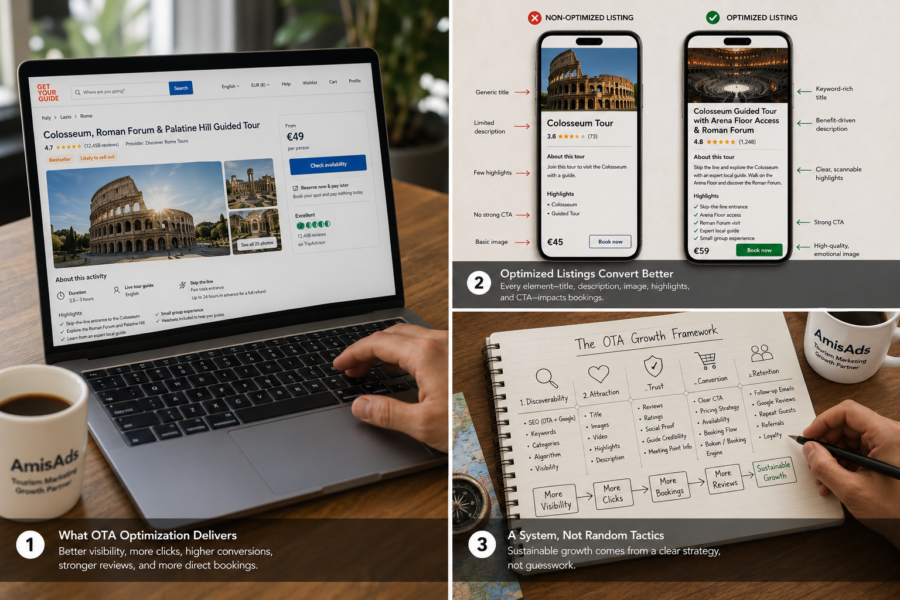
Online Travel Agencies have reshaped how experiences are sold. Travelers now discover and book through GetYourGuide, Viator, Tiqets, Headout, Civitatis and Tripadvisor Experiences long before they ever visit an operator’s own website. Yet most tour operators still treat these platforms as a filing cabinet: upload the product, set a price, wait for bookings. The results are predictable. Competition is intense, algorithms reward quality signals, and travelers compare a dozen near-identical tours before committing.
OTA optimization for tour operators is the discipline of improving every element of a listing title, description, images, itinerary, FAQs, pricing presentation, review strategy, booking flow and availability, so that it earns more visibility and converts more of the traffic it already receives. It blends search optimization, conversion rate optimization, content marketing, analytics and customer psychology into one practical growth strategy.
Done well, it is the cheapest growth lever available to a tour business, because it increases revenue from demand you are already paying commission to reach.
Why OTA Optimization Matters More Than Ever
Every major OTA runs a ranking algorithm, and every algorithm optimizes for the same thing: revenue per impression. When the platform shows your product to a traveler, it wants that impression to end in a booking, a good review and no cancellation. Listings that deliver those outcomes get shown more often. Listings that don’t quietly slide down the results page.
This creates a compounding effect that most operators underestimate. A listing with a strong click-through rate earns more impressions, which produces more bookings, which produces more reviews, which lifts ranking again. The reverse spiral is just as real, and it is why two operators running the same tour in the same city can see a five-fold difference in monthly volume.
The economics matter too. Paid advertising buys attention for as long as you keep paying. Online travel agency optimization buys position, and position persists. An operator who improves conversion from 2% to 3.5% has increased revenue by 75% without adding a single euro to their marketing budget or negotiating a lower commission rate.
The Problems OTA Optimization Solves
Most operators arrive at this work with symptoms rather than a diagnosis. These are the problems that show up most often.
Impressions without clicks
Your product appears in search results, but travelers scroll past. This is almost always a title, thumbnail or price-presentation problem, not a product problem.
Clicks without bookings
Travelers open the listing and leave. Usually the description fails to answer obvious questions, meeting point, duration, physical difficulty, what happens if it rains, and uncertainty kills the sale.
Invisible products
New listings, or listings buried under stronger competitors, receive almost no impressions. Without deliberate tour listing optimization and early review velocity, they never escape the bottom of the page.
Price-driven competition
When a listing communicates no distinct value, the only remaining differentiator is price. Operators then discount to compete, damaging margin permanently. Better positioning breaks this cycle.
Poor reviews and cancellations
Vague listings create mismatched expectations, which produce disappointed guests and negative reviews, which the algorithm punishes twice, once in ranking and once in conversion.
Operational drag
Manual availability updates across four platforms lead to overbookings, closed-out dates and wasted staff hours. Connectivity and inventory management solve this.
Total dependence on OTAs
Operators who never convert OTA exposure into brand recognition remain permanently exposed to commission changes. Optimization should also build the direct channel.
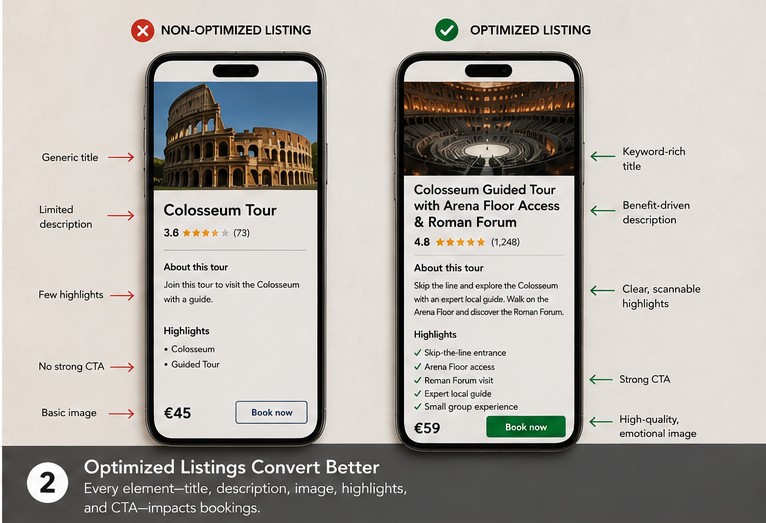
The OTA Growth Framework
Effective booking optimization follows a sequence. Skipping stages is the most common reason operators see no results.
1. Audit. Benchmark every listing against the top three competitors in your category and destination. Record impressions, click-through rate, conversion rate, review score, review count and average booking value. This establishes what to fix first.
2. Prioritize. Not all products deserve equal effort. Rank them by revenue potential; a high-margin product with strong demand and weak positioning is where the first month of work belongs.
3. Rebuild. Rewrite titles and descriptions around real search intent, replace weak imagery, structure the itinerary, add FAQs, clarify inclusions and cancellation terms, and tighten the meeting-point instructions.
4. Activate. Fix availability depth, enable instant confirmation, review pricing tiers and group options, and switch on the platform’s promotional tools where the margin supports them.
5. Measure and iterate. Change one variable at a time, give it a fair sample of impressions, keep what works. Listing optimization is a cycle, not a project with an end date.
Optimizing Titles and Descriptions
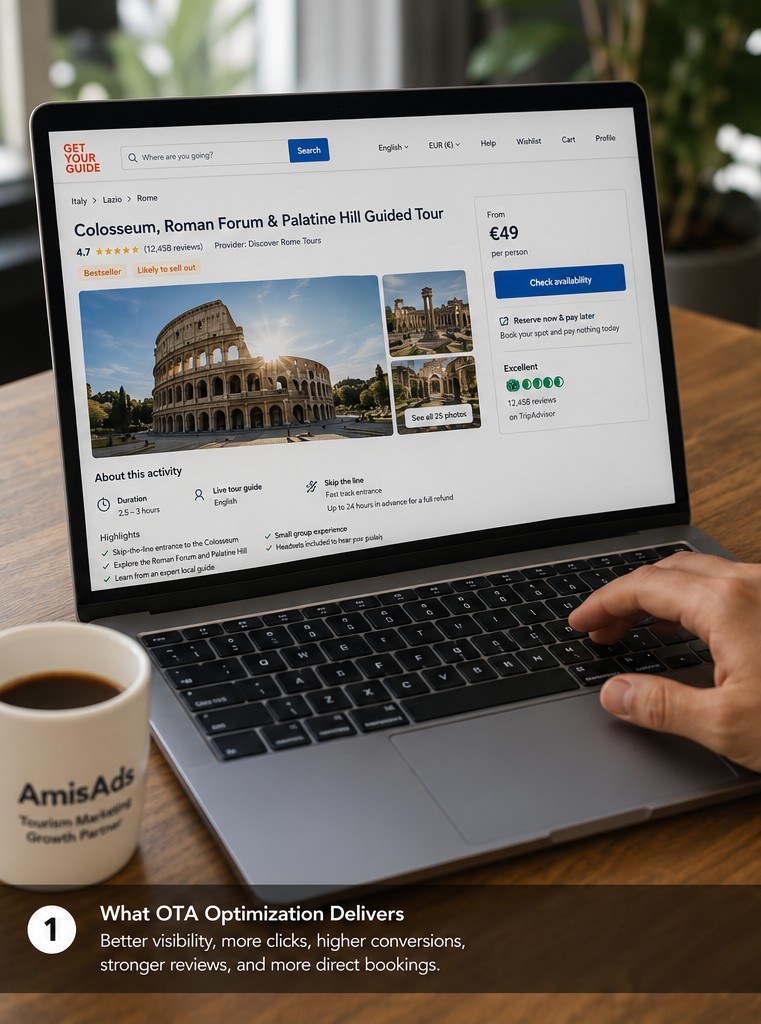
The title is the single highest-leverage element on any listing. It determines whether your product appears for a given search and whether the traveler clicks. Strong titles lead with the experience and location, include the qualifier travelers actually search for, private, small-group, skip-the-line, sunset, from [city], and stay readable when truncated on mobile.
Avoid the two most common mistakes: stuffing every keyword into one line, which reads as spam and suppresses clicks, and using an internal product name that means nothing to a traveler.
The description does a different job. It removes doubt. The opening lines should confirm the traveler is in the right place and state what makes this experience worth choosing. What follows should answer, in order, the questions a hesitant buyer is actually asking: what will I see and do, how long does it take, how demanding is it, who is it suitable for, what is included, where do we meet, and what happens if my plans change.
Write it for a nervous first-time visitor, not for the algorithm. Clarity converts, and conversion is what the algorithm rewards anyway. This applies equally to GetYourGuide optimization and Viator optimization, though each platform has its own character limits and field structures that should be respected rather than copy-pasted around.
Visual Content That Converts
Images do more work than any paragraph. The thumbnail alone can double or halve your click-through rate, and travelers form a judgment about quality in well under a second.
The strongest galleries follow a deliberate order: a hero image showing the single most recognizable moment of the experience, then real guests visibly enjoying it, then the details that build trust, the guide, the vehicle, the equipment, the food. Bright, horizontal, uncluttered images outperform dramatic but confusing ones. Stock photography of the destination almost always underperforms authentic photos of your actual tour, because travelers are buying your version of the experience, not the landmark.
Video, where a platform supports it, lifts conversion further, particularly for high-ticket and multi-hour products.
Reviews and Social Proof
Reviews are simultaneously a ranking factor, a conversion factor and a diagnostic tool. Volume matters for visibility; recency and score matter for trust.
The operators who accumulate reviews fastest do so by design. They ask at the moment of peak satisfaction, usually in person at the end of the tour, and follow up with a short message that links directly to the correct review page. They brief guides to ask consistently rather than occasionally.
Negative reviews deserve as much attention. A calm, specific, non-defensive reply signals professionalism to every future reader, and often converts better than a perfect five-star record with no responses. More importantly, recurring complaints are free product research: if three guests mention the meeting point was hard to find, the listing has a fixable problem.
Booking Systems and Operational Optimization
Listing quality generates demand; your systems determine whether you can capture it. Reservation platforms like Bokun centralize availability, connect inventory across multiple OTAs, and push real-time updates so the same seat is never sold twice.
This matters for ranking more than most operators realize. Platforms favour products with instant confirmation and deep, reliable availability, because request-to-book flows and last-minute closures lose them sales. Opening availability further ahead, keeping calendars accurate and enabling instant confirmation frequently produces a visibility gain on its own, before a single word of copy is changed.
Connectivity also frees your team from manual updates, which is where the real operational saving lives.
Where OTA Optimization and Travel SEO Meet
OTAs and your own website are not competitors; they are stages of the same funnel. Research consistently shows travelers move between channels before booking, discovering a tour on an OTA, searching the operator’s name, reading the website, then booking wherever feels safest.
That behaviour is an opportunity. Consistent branding across listings, a website that ranks for your own name and destination terms, and clear post-booking communication turn OTA exposure into direct demand over time. Strong travel SEO on your own domain also captures the long-tail questions OTAs handle poorly, and gives returning guests a reason to book with you at full margin.
The goal is not to abandon OTAs. It is to use them as a paid acquisition channel that also builds an owned audience, which is exactly what good tourism marketing should do.
Measuring Success
Track a small number of metrics consistently rather than many occasionally:
- Impressions: is the algorithm showing your product?
- Click-through rate: is the title and thumbnail earning attention?
- Conversion rate: is the listing closing the sale?
- Average booking value: are upgrades and group options working?
- Review score and velocity: is quality holding as volume grows?
- Cancellation rate: are expectations accurate?
- Branded search and direct traffic: is the owned channel growing?
Review monthly, compare like-for-like periods to account for seasonality, and resist changing five things at once. Attribution becomes impossible when every variable moves together.
Optimized vs Poorly Optimized Listings
| Optimized listing | Poorly optimized listing |
|---|---|
| Keyword-rich, intent-matched title | Generic internal product name |
| Professional, sequenced image gallery | Low-quality or stock photos |
| Clear, structured itinerary | Minimal detail |
| FAQs answering real objections | No FAQs |
| Visible trust signals and inclusions | Weak credibility |
| Deep availability, instant confirmation | Sparse calendar, request-to-book |
| Active review strategy | Passive, sporadic reviews |
Getting Started
Begin with an audit. Take your highest-revenue product, compare it honestly against the three listings that outrank it, and write down every difference in title, imagery, structure, availability and reviews. That list is your roadmap, and most operators find enough there to lift bookings meaningfully within a single season.
Want that audit done for you? Amis Ads works with tour operators to optimize listings across GetYourGuide, Viator, Tiqets, Headout and Tripadvisor Experiences, from copy and imagery to Bokun connectivity and review strategy. Request a free OTA listing audit and see exactly where your bookings are leaking.
Frequently Asked Questions
What is OTA optimization?
It is the process of improving tour listings, content, imagery, pricing, availability and reviews, to increase visibility on OTA platforms and convert more of the travelers who see them.
Which OTAs are most important?
It depends on your market and product type, but GetYourGuide, Viator, Tiqets and Headout lead in most destinations. Start where your category already shows strong demand.
Does OTA optimization replace SEO?
No. It complements your website SEO and direct-booking strategy. OTAs supply discovery volume; your own site captures branded demand and repeat customers at full margin.
Can small tour operators benefit?
Yes, often more than large ones. Algorithms rank listings, not companies, so a well-optimized single-product operator can outrank a competitor with fifty products.
How often should listings be updated?
Review performance monthly and update whenever seasonality, pricing, routes or inclusions change. Stale listings with outdated details drive cancellations and negative reviews.
Why are photos so important?
The thumbnail decides whether a traveler clicks at all, and the gallery decides whether they trust you. Imagery influences click-through and conversion more than any other single element.
How does Bokun help?
It centralizes inventory, availability and booking workflows, and pushes real-time updates to connected OTAs — reducing overbookings and supporting instant confirmation, which platforms reward.
Which metrics actually matter?
Impressions, click-through rate, conversion rate, average booking value, review score and velocity, cancellation rate, and growth in branded search or direct traffic.
Should I use the same text on every platform?
No. Each platform has different field structures, character limits and audiences. Duplicated copy performs poorly and wastes the ranking opportunity each platform offers.
What is the first step?
Audit your current listings, benchmark them against the competitors outranking you, and prioritize your highest-value products first.